

Health Library
Appendectomy
Appendix removal; Surgery - appendectomy; Appendicitis - appendectomy
An appendectomy is surgery to remove the appendix.
Images
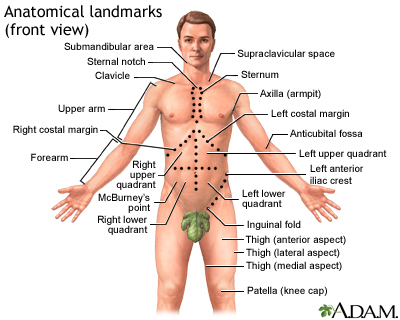
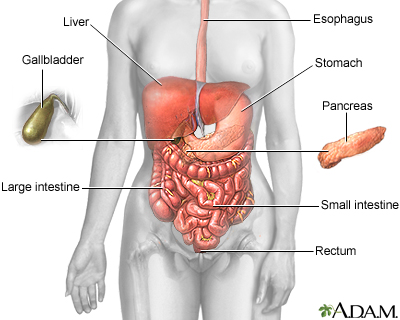
Presentation

I Would Like to Learn About:
Description
The appendix is a small, finger-shaped organ that branches off from the first part of the large intestine (colon). When it becomes swollen (inflamed) or infected, the condition is called appendicitis. When you have appendicitis, your appendix may need to be removed. An appendix that has a hole in it can leak and infect the entire abdomen area. This can be life threatening.
An appendectomy is done using either:
- General anesthesia -- You will be asleep and not feel any pain during the surgery.
- Spinal anesthesia -- Medicine is put into your lower back to make you numb below your waist. You will also get medicine to make you sleepy.
Your surgeon may make a small cut in the lower right side of your belly area and remove the appendix.
Your appendix can also be removed using small surgical cuts and a camera. This is called a laparoscopic appendectomy.
If your appendix broke open or a pocket of infection (abscess) formed, your abdomen may be washed out during surgery. A small tube may be left in the belly area to help drain out fluids or pus.
Why the Procedure Is Performed
An appendectomy is done for appendicitis. The condition can be hard to diagnose, especially in children, older people, and women of childbearing age.
Most often, the first symptom is pain around your belly button:
- The pain may be mild at first, but it becomes sharp and severe.
- The pain often moves into your right lower abdomen and becomes more focused in this area.
Other symptoms include:
- Diarrhea or constipation
- Fever (usually not very high)
- Nausea and vomiting
- Reduced appetite
If you have symptoms of appendicitis, seek medical help right away. Do not use heating pads, enemas, laxatives, or other home treatments to try to relieve symptoms.
Your health care provider will examine your abdomen and may perform a rectal exam and pelvic exam. Other tests may be done:
- Blood tests, including a white blood cell (WBC) count, may be done to check for infection.
- Your provider may order a CT scan or ultrasound to determine if the appendix is the cause of the problem since other illnesses can cause the same or similar symptoms.
The goal is to remove an infected appendix before it breaks open (ruptures). After reviewing your symptoms and the results of the physical exam and medical tests, your surgeon will decide whether you need surgery.
Today, many cases of appendicitis are treated with antibiotics only, without an operation. Ask your provider if you are a candidate for this.
Risks
Risks of anesthesia and surgery in general include:
- Reactions to medicines
- Problems breathing
- Bleeding, blood clots, or infection
Risks of an appendectomy after a ruptured appendix include:
- Buildup of pus (abscess), which may need draining and antibiotics
- Infection of the incision
After the Procedure
Most people leave the hospital in 1 to 2 days after surgery. You can go back to your normal activities within a few weeks after leaving the hospital though it may take several weeks to get back to your normal energy level.
If you had laparoscopic surgery, you will likely recover quickly. Recovery is slower and more complicated if your appendix has broken open or an abscess has formed.
Living without an appendix causes no known major health problems.
Related Information
AppendicitisPeritonitis
Abscess
Abdominal pain
Fever
WBC count
References
Quick CRG, Biers SM, Arulampalam THA. Appendicitis. In: Quick CRG, Biers SM, Arulampalam THA, eds. Essential Surgery: Problems Diagnosis and Management. 7th ed. Philadelphia, PA: Elsevier Limited; 2026:chap 26.
Sanchez SE, Counihan D, Kanu E, Blazer DG. The appendix. In: Tyler DS, Hayes-Dixon A, Hines OJ, et al, eds. Sabiston Textbook of Surgery. 22nd ed. Philadelphia, PA: Elsevier; 2026:chap 94.
Sevinc B, Damburaci N, Karahan O. Nonoperative management of uncomplicated acute appendicitis; results of 5 years follow. Langenbeck's Arch Surg. 2025; 410(1):292. PMID: 41055745 pubmed.ncbi.nlm.nih.gov/41055745/.
Zhang IY, Flum DR. Appendicitis. In: Chung RT, Rubin DT, Wilcox CM, eds. Sleisenger and Fordtran's Gastrointestinal and Liver Disease: Pathophysiology/Diagnosis/Management. 12th ed. Philadelphia, PA: Elsevier; 2026:chap 122.
BACK TO TOPReview Date: 1/1/2026
Reviewed By: Ann M. Rogers, MD, FACS, Professor Emeritus, Department of Surgery, Penn State College of Medicine, Hershey, PA. Also reviewed by David C. Dugdale, MD, Medical Director, Brenda Conaway, Editorial Director, and the A.D.A.M. Editorial team.
 | A.D.A.M., Inc. is accredited by URAC, for Health Content Provider (www.urac.org). URAC's accreditation program is an independent audit to verify that A.D.A.M. follows rigorous standards of quality and accountability. A.D.A.M. is among the first to achieve this important distinction for online health information and services. Learn more about A.D.A.M.'s editorial policy, editorial process and privacy policy. A.D.A.M. is also a founding member of Hi-Ethics. This site complies with the HONcode standard for trustworthy health information: verify here. |
The information provided herein should not be used during any medical emergency or for the diagnosis or treatment of any medical condition. A licensed medical professional should be consulted for diagnosis and treatment of any and all medical conditions. Links to other sites are provided for information only -- they do not constitute endorsements of those other sites. No warranty of any kind, either expressed or implied, is made as to the accuracy, reliability, timeliness, or correctness of any translations made by a third-party service of the information provided herein into any other language.
© 1997-
2026 A.D.A.M., a business unit of Ebix, Inc. Any duplication or distribution of the information contained herein is strictly prohibited.
All content on this site including text, images, graphics, audio, video, data, metadata, and compilations is protected by copyright and other intellectual property laws. You may view the content for personal, noncommercial use. Any other use requires prior written consent from Ebix. You may not copy, reproduce, distribute, transmit, display, publish, reverse-engineer, adapt, modify, store beyond ordinary browser caching, index, mine, scrape, or create derivative works from this content. You may not use automated tools to access or extract content, including to create embeddings, vectors, datasets, or indexes for retrieval systems. Use of any content for training, fine-tuning, calibrating, testing, evaluating, or improving AI systems of any kind is prohibited without express written consent. This includes large language models, machine learning models, neural networks, generative systems, retrieval-augmented systems, and any software that ingests content to produce outputs. Any unauthorized use of the content including AI-related use is a violation of our rights and may result in legal action, damages, and statutory penalties to the fullest extent permitted by law. Ebix reserves the right to enforce its rights through legal, technological, and contractual measures.
