

Health Library
Wart remover poisoning
Wart removers are medicines used to get rid of warts. Warts are small growths on the skin that are caused by a virus. They are usually painless. Wart remover poisoning occurs when someone swallows or applies more than the normal or recommended amount of this medicine. This can be by accident or on purpose.
This article is for information only. DO NOT use it to treat or manage an actual poison exposure. If you or someone you are with has an exposure, call the local emergency number (such as 911) or the local poison control center can be reached directly by calling the national, toll-free Poison Help hotline (1-800-222-1222) from anywhere in the United States.
Images
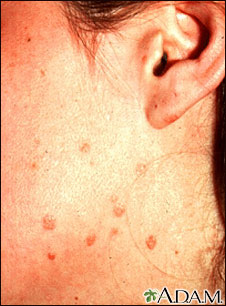
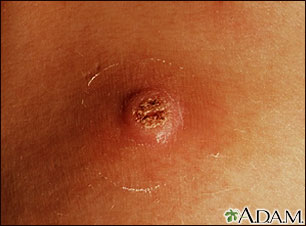
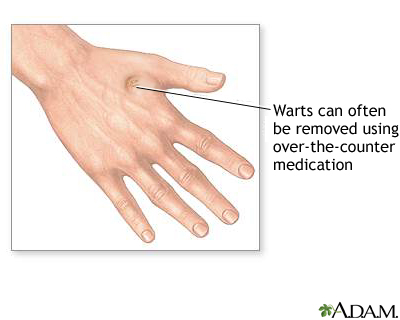
I Would Like to Learn About:
Poisonous Ingredient
The poisonous ingredients include:
- Salicylates
- Other acids
Where Found
Ingredients in wart remover medicines that can be poisonous are found in many products, such as:
- Clear Away
- Clear Away Plantar
- Compound W
- DuoFilm
- DuoFilm patch
- DuoPlant for Feet
- Freezone
- Gordofilm
- Hydrisalic
- Keralyt
- Wart-Off Freeze
- Mediplast
- Mosco
- Occlusal
- Occlusal-HP
- Off-Ezy Wart Remover
- Salactic Film
- Trans-Ver-Sal
- Wart Remover
Other products may also contain salicylates and other acids.
Symptoms
Below are symptoms of wart remover poisoning in different parts of the body.
AIRWAYS AND LUNGS
- No breathing
- Rapid breathing
- Shallow breathing
- Fluid in the lungs
EYES, EARS, NOSE, AND THROAT
- Eye irritation
- Loss of vision
- Ringing in the ears (tinnitus)
- Thirst
- Throat burning and swelling
KIDNEYS
- Kidney failure
NERVOUS SYSTEM
- Agitation
- Collapse
- Convulsions (seizures)
- Dizziness
- Drowsiness
- Fever
- Hallucinations
- Hyperactivity
SKIN
- Rash (usually an allergic reaction)
- Mild burn (from very high amounts on the skin)
STOMACH AND INTESTINES
- Loss of appetite
- Nausea and vomiting, possibly with blood
Home Care
Seek medical help right away. Do NOT make the person throw up unless poison control or a health care provider tells you to do so. Flush the eyes with water and remove any medicine that remains on the skin.
Before Calling Emergency
Have this information ready:
- The person's age, weight, and condition
- The name of the product (ingredients and strength, if known)
- The time it was swallowed
- The amount swallowed
Poison Control
The local poison control center can be reached directly by calling the national, toll-free Poison Help hotline (1-800-222-1222) from anywhere in the United States. This national hotline will let you talk to experts in poisoning. They will give you further instructions.
This is a free and confidential service. All local poison control centers in the United States use this national number. You should call if you have any questions about poisoning or poison prevention. It does NOT need to be an emergency. You can call for any reason, 24 hours a day, 7 days a week.
You can also get online poison help now at Poisonhelp.org. Just enter the product, poison, or medicine to get expert help.
What to Expect at the Emergency Room
If you go to the emergency room, take the medicine container with you, if possible.
Your provider will measure and monitor your vital signs, including temperature, pulse, breathing rate, and blood pressure. Symptoms will be treated.
If the medicine was swallowed, tests may include:
- Blood and urine tests
- Chest x-ray
- CT scan (advanced imaging) of the brain for neurologic symptoms
- Electrocardiogram (ECG), or heart tracing
Treatment may include:
- Activated charcoal
- Breathing support, including oxygen, tube through the mouth into the lungs, and breathing machine (ventilator)
- Fluids through a vein (IV)
- Laxative
- Medicines to treat symptoms
- Dialysis (kidney machine), in severe cases
If the poisoning is from skin exposure, the person may receive:
- Washing (irrigation) of the skin, perhaps every few hours for several days
- Antibiotic ointment (after skin irrigation)
- Surgery to remove burned skin (debridement)
If the poisoning is from eye exposure, the person may receive:
- Eye irrigation (washing)
- Application of eyedrops
Vomiting of blood is a sign of bleeding in the stomach or intestines. A procedure called an endoscopy may be needed to stop the bleeding. In an endoscopy, a tube is placed through the mouth into the stomach and upper intestine.
Outlook (Prognosis)
How well a person does depends on how much poison entered the blood and how quickly treatment was received. People can recover if the effect of the poison can be stopped. Kidney damage can be permanent.
References
Aronson JK. Salicylates, topical. In: Aronson JK, ed. Meyler's Side Effects of Drugs. 16th ed. Waltham, MA: Elsevier; 2016:293.
Hatten BW. Aspirin and nonsteroidal agents. In: Walls RM, ed. Rosen's Emergency Medicine: Concepts and Clinical Practice. 10th ed. Philadelphia, PA: Elsevier; 2023:chap 139.
Meehan TJ. Care of the poisoned patient. In: Walls RM, ed. Rosen's Emergency Medicine: Concepts and Clinical Practice. 10th ed. Philadelphia, PA: Elsevier; 2023:chap 135.
BACK TO TOPReview Date: 7/1/2025
Reviewed By: Jesse Borke, MD, CPE, FAAEM, FACEP, Attending Physician at Kaiser Permanente, Orange County, CA. Also reviewed by David C. Dugdale, MD, Medical Director, Brenda Conaway, Editorial Director, and the A.D.A.M. Editorial team.
 | A.D.A.M., Inc. is accredited by URAC, for Health Content Provider (www.urac.org). URAC's accreditation program is an independent audit to verify that A.D.A.M. follows rigorous standards of quality and accountability. A.D.A.M. is among the first to achieve this important distinction for online health information and services. Learn more about A.D.A.M.'s editorial policy, editorial process and privacy policy. A.D.A.M. is also a founding member of Hi-Ethics. This site complies with the HONcode standard for trustworthy health information: verify here. |
The information provided herein should not be used during any medical emergency or for the diagnosis or treatment of any medical condition. A licensed medical professional should be consulted for diagnosis and treatment of any and all medical conditions. Links to other sites are provided for information only -- they do not constitute endorsements of those other sites. No warranty of any kind, either expressed or implied, is made as to the accuracy, reliability, timeliness, or correctness of any translations made by a third-party service of the information provided herein into any other language.
© 1997-
2026 A.D.A.M., a business unit of Ebix, Inc. Any duplication or distribution of the information contained herein is strictly prohibited.
All content on this site including text, images, graphics, audio, video, data, metadata, and compilations is protected by copyright and other intellectual property laws. You may view the content for personal, noncommercial use. Any other use requires prior written consent from Ebix. You may not copy, reproduce, distribute, transmit, display, publish, reverse-engineer, adapt, modify, store beyond ordinary browser caching, index, mine, scrape, or create derivative works from this content. You may not use automated tools to access or extract content, including to create embeddings, vectors, datasets, or indexes for retrieval systems. Use of any content for training, fine-tuning, calibrating, testing, evaluating, or improving AI systems of any kind is prohibited without express written consent. This includes large language models, machine learning models, neural networks, generative systems, retrieval-augmented systems, and any software that ingests content to produce outputs. Any unauthorized use of the content including AI-related use is a violation of our rights and may result in legal action, damages, and statutory penalties to the fullest extent permitted by law. Ebix reserves the right to enforce its rights through legal, technological, and contractual measures.
