

Health Library
Eye floaters
Specks in your vision; Vitreous floaters
Eye floaters are small specks, dots or lines that appear in front of your eyes but are actually present inside the eyes. They are often visible when your field of vision is clear and light in color such as when looking at the blue sky, or a white wall. They are caused by age-related changes in the eyes.
Images

I Would Like to Learn About:
Information
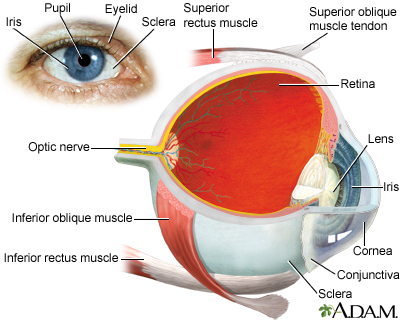
The floating specks you sometimes see in front of your eyes are not on the surface of your eyes but inside them. They are made up of bits of cell debris that drift around in the fluid (vitreous) in the back of your eye. Floaters may look like spots, specks, bubbles, threads, or clumps. Most adults have at least a few floaters. There are times when they may be more visible than at other times, such as when you are reading, especially if the floater is dense or dark.
Most of the time floaters are harmless. However, they can be a symptom of a tear in the retina. If you notice a sudden increase in floaters or if you see floaters along with flashes of light in your side vision, this may be a symptom of a retinal tear or detachment. Go to an eye doctor or emergency room if you have these symptoms.
Treatment
It is difficult to eliminate floaters. A vitrectomy can remove floaters, but it is a major eye operation and many doctors feel that it is too risky for a minor problem such as floaters. A YAG laser treatment can break up floaters and possibly make them less visible, but it doesn't really remove the floaters. Research is being done on femtosecond lasers (like the ones often used in LASIK) since this method may prove to be safer. Atropine eye drops, which slightly dilate the pupil, can make floaters less visible. However, the drops may cause blurred vision. Some homeopathic eye drops are marketed as treatment for floaters, but not been shown to have proven benefit.
References
Aleman AI, Kiryakoza L, Sridhar J, Sengillo J. Management of vitreous floaters: a review. Curr Opin Ophthalmol. 2024;35(5):365-368. PMID: 39046174 pubmed.ncbi.nlm.nih.gov/39046174/.
Guluma K, Lee JE. Ophthalmology. In: Walls RM, ed. Rosen's Emergency Medicine: Concepts and Clinical Practice. 10th ed. Philadelphia, PA: Elsevier; 2023:chap 57.
BACK TO TOPReview Date: 10/20/2025
Reviewed By: Franklin W. Lusby, MD, Ophthalmologist, Lusby Vision Institute, La Jolla, CA. Also reviewed by David C. Dugdale, MD, Medical Director, Brenda Conaway, Editorial Director, and the A.D.A.M. Editorial team.
 | A.D.A.M., Inc. is accredited by URAC, for Health Content Provider (www.urac.org). URAC's accreditation program is an independent audit to verify that A.D.A.M. follows rigorous standards of quality and accountability. A.D.A.M. is among the first to achieve this important distinction for online health information and services. Learn more about A.D.A.M.'s editorial policy, editorial process and privacy policy. A.D.A.M. is also a founding member of Hi-Ethics. This site complies with the HONcode standard for trustworthy health information: verify here. |
The information provided herein should not be used during any medical emergency or for the diagnosis or treatment of any medical condition. A licensed medical professional should be consulted for diagnosis and treatment of any and all medical conditions. Links to other sites are provided for information only -- they do not constitute endorsements of those other sites. No warranty of any kind, either expressed or implied, is made as to the accuracy, reliability, timeliness, or correctness of any translations made by a third-party service of the information provided herein into any other language.
© 1997-
2026 A.D.A.M., a business unit of Ebix, Inc. Any duplication or distribution of the information contained herein is strictly prohibited.
All content on this site including text, images, graphics, audio, video, data, metadata, and compilations is protected by copyright and other intellectual property laws. You may view the content for personal, noncommercial use. Any other use requires prior written consent from Ebix. You may not copy, reproduce, distribute, transmit, display, publish, reverse-engineer, adapt, modify, store beyond ordinary browser caching, index, mine, scrape, or create derivative works from this content. You may not use automated tools to access or extract content, including to create embeddings, vectors, datasets, or indexes for retrieval systems. Use of any content for training, fine-tuning, calibrating, testing, evaluating, or improving AI systems of any kind is prohibited without express written consent. This includes large language models, machine learning models, neural networks, generative systems, retrieval-augmented systems, and any software that ingests content to produce outputs. Any unauthorized use of the content including AI-related use is a violation of our rights and may result in legal action, damages, and statutory penalties to the fullest extent permitted by law. Ebix reserves the right to enforce its rights through legal, technological, and contractual measures.
