

Health Library
Autosomal dominant
Inheritance - autosomal dominant; Genetics - autosomal dominant
Autosomal dominant is one of many ways that a genetic trait or disorder can be passed down through families.
In an autosomal dominant disease, if you get the variant gene from only one parent, you can get the disease. Often, one of the parents may also have the disease. However, many autosomal dominant disorders' gene variant arises de novo, or for the first time in a family, in the affected person.
Images
I Would Like to Learn About:
Information
Most human beings have cells with 46 chromosomes. These consist of 2 chromosomes that determine what sex they are (X and Y chromosomes), and 22 pairs of nonsex (autosomal) chromosomes. Typically, males are "46,XY" and females are "46,XX." Inheriting a disease, condition, or trait depends on the type of chromosome affected (nonsex or sex chromosome). It also depends on whether the trait is dominant or recessive.
A single variant gene on one of the nonsex (autosomal) chromosomes from either parent can cause an autosomal disorder.
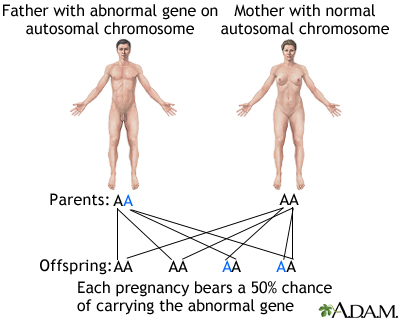
Dominant inheritance means a variant gene from one parent can cause disease. This happens even when the matching gene from the other parent is normal. The variant gene dominates.
This disease can also occur as a new condition in a child when neither parent has the variant gene.
A parent with an autosomal dominant condition has a 50% chance of having a child with the condition. This is true for each pregnancy.
It means that each child's risk for the disease does not depend on whether their sibling has the disease.
Children who do not inherit the variant gene will not develop or pass on the disease.
If someone is diagnosed with an autosomal dominant disease, their parents should also be tested for the variant gene.
Examples of autosomal dominant disorders include Marfan syndrome and neurofibromatosis type 1.
Related Information
GenesChromosome
Genetics
References
Jones KL, Jones MC, del Campo M. Genetics, genetic counseling, and prevention. In: Jones KL, Jones MC, del Campo M, eds. Smith's Recognizable Patterns of Human Malformation. 8th ed. Philadelphia, PA: Elsevier; 2022:chap 2.
Korf BR, Limdi NA. Principles of genetics. In: Goldman L, Cooney KA, eds. Goldman-Cecil Medicine. 27th ed. Philadelphia, PA: Elsevier; 2024:chap 31.
Scott DA, Lee B. Patterns of genetic transmission. In: Kliegman RM, St. Geme JW, Blum NJ, et al, eds. Nelson Textbook of Pediatrics. 22nd ed. Philadelphia, PA: Elsevier; 2025:chap 97.
Sondheimer N. Patterns of single-gene inheritance. In: Cohn RD, Scherer SW, Hamosh A, eds. Thompson & Thompson Genetics and Genomics in Medicine. 9th ed. Philadelphia, PA: Elsevier; 2024:chap 7.
Yilmaz F, Beck CR, Lee C. The chromosomal and genomic basis of disease: Disorders of the autosomes and sex chromosomes. In: Cohn RD, Scherer SW, Hamosh A, eds. Thompson & Thompson Genetics and Genomics in Medicine. 9th ed. Philadelphia, PA: Elsevier; 2024:chap 6.
BACK TO TOPReview Date: 1/26/2026
Reviewed By: Anna C. Edens Hurst, MD, MS, Professor in Medical Genetics, The University of Alabama at Birmingham, Birmingham, AL. Review provided by VeriMed Healthcare Network. Also reviewed by David C. Dugdale, MD, Medical Director, Brenda Conaway, Editorial Director, and the A.D.A.M. Editorial team.
 | A.D.A.M., Inc. is accredited by URAC, for Health Content Provider (www.urac.org). URAC's accreditation program is an independent audit to verify that A.D.A.M. follows rigorous standards of quality and accountability. A.D.A.M. is among the first to achieve this important distinction for online health information and services. Learn more about A.D.A.M.'s editorial policy, editorial process and privacy policy. A.D.A.M. is also a founding member of Hi-Ethics. This site complies with the HONcode standard for trustworthy health information: verify here. |
The information provided herein should not be used during any medical emergency or for the diagnosis or treatment of any medical condition. A licensed medical professional should be consulted for diagnosis and treatment of any and all medical conditions. Links to other sites are provided for information only -- they do not constitute endorsements of those other sites. No warranty of any kind, either expressed or implied, is made as to the accuracy, reliability, timeliness, or correctness of any translations made by a third-party service of the information provided herein into any other language.
© 1997-
2026 A.D.A.M., a business unit of Ebix, Inc. Any duplication or distribution of the information contained herein is strictly prohibited.
All content on this site including text, images, graphics, audio, video, data, metadata, and compilations is protected by copyright and other intellectual property laws. You may view the content for personal, noncommercial use. Any other use requires prior written consent from Ebix. You may not copy, reproduce, distribute, transmit, display, publish, reverse-engineer, adapt, modify, store beyond ordinary browser caching, index, mine, scrape, or create derivative works from this content. You may not use automated tools to access or extract content, including to create embeddings, vectors, datasets, or indexes for retrieval systems. Use of any content for training, fine-tuning, calibrating, testing, evaluating, or improving AI systems of any kind is prohibited without express written consent. This includes large language models, machine learning models, neural networks, generative systems, retrieval-augmented systems, and any software that ingests content to produce outputs. Any unauthorized use of the content including AI-related use is a violation of our rights and may result in legal action, damages, and statutory penalties to the fullest extent permitted by law. Ebix reserves the right to enforce its rights through legal, technological, and contractual measures.
