

Health Library
Trisomy 18
Edwards syndrome
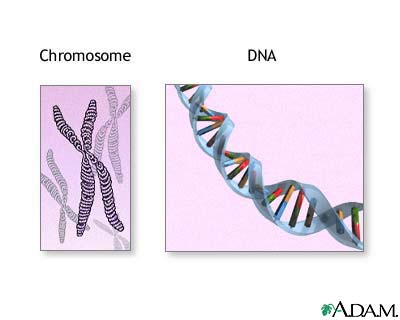
Trisomy 18 is a genetic condition in which a person has a third copy of material from chromosome 18, instead of the usual 2 copies. Rarely, the extra material may be attached to another chromosome (translocation). Most cases are not passed down through families. Instead, the problems that lead to this condition occur in either the sperm or the egg that forms the fetus.
Images
I Would Like to Learn About:
Causes
Trisomy 18 occurs in 1 in 6000 live births. It is 3 times more common in girls than boys.
The syndrome occurs when there is extra material from chromosome 18. The extra material affects normal development.
- Trisomy 18: the presence of an extra (third) chromosome 18 in all of the cells.
- Mosaic trisomy 18: the presence of an extra chromosome 18 in some of the cells.
- Partial trisomy 18: the presence of a part of an extra chromosome 18 in the cells.
Most cases of Trisomy 18 are not passed down through families (inherited). Instead, the events that lead to trisomy 18 occur in either the sperm or the egg that forms the fetus.
Symptoms
Symptoms may include:
- Clenched hands
- Crossed legs
- Feet with a rounded bottom (rocker-bottom feet)
- Low birth weight
- Low-set ears
- Mental delay
- Poorly developed fingernails
- Small head (microcephaly)
- Small jaw (micrognathia)
- Undescended testicle
- Unusual shaped chest (pectus carinatum)
Exams and Tests
An exam during pregnancy may show an unusually large uterus and extra amniotic fluid. There may be an unusually small placenta when the baby is born. A physical exam of the infant may show unusual facial features and fingerprint patterns. X-rays may show a short breast bone.
Chromosome studies will show trisomy 18. The chromosome abnormality may be present in every cell or present in only a certain percentage of the cells (called mosaicism). Studies may also show part of the chromosome in some cells. Rarely, part of the chromosome 18 becomes attached to another chromosome. This is called translocation.
Other signs include:
- Hole, split, or cleft in the iris of the eye (coloboma)
- Separation between the left and right side of the abdominal muscle (diastasis recti)
- Umbilical hernia or inguinal hernia
There are often signs of congenital heart disease, such as:
- Atrial septal defect (ASD)
- Patent ductus arteriosus (PDA)
- Ventricular septal defect (VSD)
Tests may also show kidney problems, including:
- Horseshoe kidney
- Hydronephrosis
- Polycystic kidney
Treatment
There are no specific treatments for trisomy 18. Which treatments are used depend on the person's individual condition.
Support Groups
More information and support for people with Trisomy 18 and their families can be found at:
- Support Organization for Trisomy 18, 13 and Related Disorders (SOFT): trisomy.org
- Trisomy 18 Foundation: www.trisomy18.org
- Hope for Trisomy 13 and 18: www.hopefortrisomy13and18.org
Outlook (Prognosis)
One half of infants with this condition do not survive beyond the first week of life. Nine out of ten children will die by 1 year of age. Some children have survived to the teenage years, but with serious medical and developmental problems.
Possible Complications
Complications depend on the specific defects and symptoms.
Complications may include:
- Breathing difficulty or lack of breathing (apnea)
- Deafness
- Feeding problems
- Heart failure
- Seizures
- Vision problems
When to Contact a Medical Professional
Genetic counseling can help families understand the condition, the risks of inheriting it, and how to care for the person.
Prevention
Trisomy 18 can be diagnosed before birth by amniocentesis with chromosome studies of the amniotic cells. In some situations, testing by maternal serum screening for cell-free fetal DNA detection, or chorionic villus sampling may be considered.
Genetic counseling is recommended for parents who have a child with this syndrome and who want to have more children.
Related Information
ChromosomeReferences
Bacino CA, Lee B. Chromosome disorders. In: Kliegman RM, St. Geme JW, Blum NJ, et al, eds. Nelson Textbook of Pediatrics. 22nd ed. Philadelphia, PA: Elsevier; 2025:chap 99.
Madan-Khetarpal S, Arnold G. Genetic disorders and dysmorphic conditions. In: Zitelli BJ, McIntire SC, Nowalk AJ, eds. Zitelli and Davis' Atlas of Pediatric Physical Diagnosis. 8th ed. Philadelphia, PA: Elsevier; 2023:chap 1.
National Institutes of Health. National Center for Advancing Translational Sciences. Genetic and Rare Diseases Information Center website. Trisomy 18. rarediseases.info.nih.gov/diseases/6321/trisomy-18. Updated February 2026. Accessed March 6, 2026.
Ozarslan N, Gaw SL, Platt LD. Trisomy 18. In: Copel JA, D'Alton ME, Feltovich H, et al, eds. Obstetric Imaging: Fetal Diagnosis and Care. 3rd ed. Philadelphia, PA: Elsevier; 2023:chap 125.
BACK TO TOPReview Date: 7/28/2025
Reviewed By: Anna C. Edens Hurst, MD, MS, Associate Professor in Medical Genetics, The University of Alabama at Birmingham, Birmingham, AL. Review provided by VeriMed Healthcare Network. Also reviewed by David C. Dugdale, MD, Medical Director, Brenda Conaway, Editorial Director, and the A.D.A.M. Editorial team.
 | A.D.A.M., Inc. is accredited by URAC, for Health Content Provider (www.urac.org). URAC's accreditation program is an independent audit to verify that A.D.A.M. follows rigorous standards of quality and accountability. A.D.A.M. is among the first to achieve this important distinction for online health information and services. Learn more about A.D.A.M.'s editorial policy, editorial process and privacy policy. A.D.A.M. is also a founding member of Hi-Ethics. This site complies with the HONcode standard for trustworthy health information: verify here. |
The information provided herein should not be used during any medical emergency or for the diagnosis or treatment of any medical condition. A licensed medical professional should be consulted for diagnosis and treatment of any and all medical conditions. Links to other sites are provided for information only -- they do not constitute endorsements of those other sites. No warranty of any kind, either expressed or implied, is made as to the accuracy, reliability, timeliness, or correctness of any translations made by a third-party service of the information provided herein into any other language.
© 1997-
2026 A.D.A.M., a business unit of Ebix, Inc. Any duplication or distribution of the information contained herein is strictly prohibited.
All content on this site including text, images, graphics, audio, video, data, metadata, and compilations is protected by copyright and other intellectual property laws. You may view the content for personal, noncommercial use. Any other use requires prior written consent from Ebix. You may not copy, reproduce, distribute, transmit, display, publish, reverse-engineer, adapt, modify, store beyond ordinary browser caching, index, mine, scrape, or create derivative works from this content. You may not use automated tools to access or extract content, including to create embeddings, vectors, datasets, or indexes for retrieval systems. Use of any content for training, fine-tuning, calibrating, testing, evaluating, or improving AI systems of any kind is prohibited without express written consent. This includes large language models, machine learning models, neural networks, generative systems, retrieval-augmented systems, and any software that ingests content to produce outputs. Any unauthorized use of the content including AI-related use is a violation of our rights and may result in legal action, damages, and statutory penalties to the fullest extent permitted by law. Ebix reserves the right to enforce its rights through legal, technological, and contractual measures.
