

Health Library
Agranulocytosis
Granulocytopenia; Granulopenia; Neutropenia
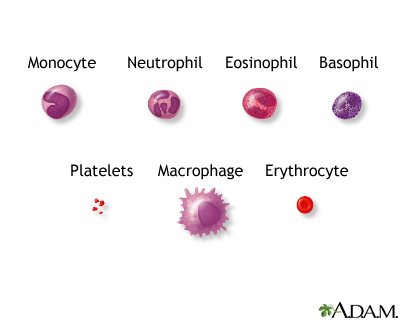
White blood cells fight infections from bacteria, viruses, fungi, and other germs. One important type of white blood cell is the granulocyte, which is made in the bone marrow and travels in the blood throughout the body. Granulocytes sense infections, gather at sites of infection, and destroy the germs.
When the body has too few granulocytes, the condition is called agranulocytosis. This makes it harder for the body to fight off germs. As a result, the person may get sick from infections.
Images
I Would Like to Learn About:
Causes
Agranulocytosis may be caused by:
- Autoimmune diseases
- Bone marrow diseases, such as myelodysplasia or large granular lymphocyte (LGL) leukemia
- Certain medicines used to treat diseases, including cancer
- Certain street drugs
- Poor nutrition
- Preparation for bone marrow transplant
- Benign familial neutropenia
- Genetic variants, especially in people of certain African and Caribbean ethnicities
Symptoms
Symptoms of this condition may include:
Exams and Tests
A white blood cell differential test will be done to measure the percentage of each type of white blood cell in your blood.
Other tests to diagnose the condition may include:
- Bone marrow biopsy
- Neutrophil antibody tests (blood test)
Treatment
The treatment depends on the cause of the low white blood cell count. For example, if a medicine is the cause, stopping or changing to another medicine may help. In other cases, medicines to help the body make more white blood cells will be used. In certain ethnic groups with benign familial neutropenia, no treatment is needed.
Outlook (Prognosis)
Treating or removing the cause can result in a good outcome.
Prevention
If you are having treatment or taking medicine that could cause agranulocytosis, your health care provider will use blood tests to monitor you.
Related Information
GranulocyteBlood differential test
References
Berliner N. Leukocytosis and leukopenia. In: Goldman L, Cooney KA, eds. Goldman-Cecil Medicine. 27th ed. Philadelphia, PA: Elsevier; 2024:chap 153.
Rice L, Zieske AW, Jung M. Neutrophilic leukocytosis, neutropenia, monocytosis, and monocytopenia. In: Hoffman R, Benz EJ, Silberstein LE, et al, eds. Hematology: Basic Principles and Practice. 8th ed. Philadelphia, PA: Elsevier; 2023:chap 49.
BACK TO TOPReview Date: 5/1/2026
Reviewed By: Warren Brenner, MD, Oncologist, Lynn Cancer Institute, Boca Raton, FL. Review provided by VeriMed Healthcare Network. Also reviewed by David C. Dugdale, MD, Medical Director, Brenda Conaway, Editorial Director, and the A.D.A.M. Editorial team.
 | A.D.A.M., Inc. is accredited by URAC, for Health Content Provider (www.urac.org). URAC's accreditation program is an independent audit to verify that A.D.A.M. follows rigorous standards of quality and accountability. A.D.A.M. is among the first to achieve this important distinction for online health information and services. Learn more about A.D.A.M.'s editorial policy, editorial process and privacy policy. A.D.A.M. is also a founding member of Hi-Ethics. This site complies with the HONcode standard for trustworthy health information: verify here. |
The information provided herein should not be used during any medical emergency or for the diagnosis or treatment of any medical condition. A licensed medical professional should be consulted for diagnosis and treatment of any and all medical conditions. Links to other sites are provided for information only -- they do not constitute endorsements of those other sites. No warranty of any kind, either expressed or implied, is made as to the accuracy, reliability, timeliness, or correctness of any translations made by a third-party service of the information provided herein into any other language.
© 1997-
2026 A.D.A.M., a business unit of Ebix, Inc. Any duplication or distribution of the information contained herein is strictly prohibited.
All content on this site including text, images, graphics, audio, video, data, metadata, and compilations is protected by copyright and other intellectual property laws. You may view the content for personal, noncommercial use. Any other use requires prior written consent from Ebix. You may not copy, reproduce, distribute, transmit, display, publish, reverse-engineer, adapt, modify, store beyond ordinary browser caching, index, mine, scrape, or create derivative works from this content. You may not use automated tools to access or extract content, including to create embeddings, vectors, datasets, or indexes for retrieval systems. Use of any content for training, fine-tuning, calibrating, testing, evaluating, or improving AI systems of any kind is prohibited without express written consent. This includes large language models, machine learning models, neural networks, generative systems, retrieval-augmented systems, and any software that ingests content to produce outputs. Any unauthorized use of the content including AI-related use is a violation of our rights and may result in legal action, damages, and statutory penalties to the fullest extent permitted by law. Ebix reserves the right to enforce its rights through legal, technological, and contractual measures.
