

Health Library
Sertoli-Leydig cell tumor
Sertoli-stromal cell tumor; Arrhenoblastoma; Androblastoma; Ovarian cancer - Sertoli-Leydig cell tumor
Sertoli-Leydig cell tumor (SLCT) is a rare cancer of the ovaries. The cancer cells produce and release a male sex hormone called testosterone.
Images
I Would Like to Learn About:
Causes
The exact cause of this tumor is not known. Changes (alterations) in genes may play a role.
SLCT occurs most often in young women 20 to 30 years old. But the tumor can occur at any age.
Symptoms
The Sertoli cells are normally located in the male reproductive glands (the testes). They feed sperm cells. The Leydig cells, also located in the testes, release a male sex hormone.
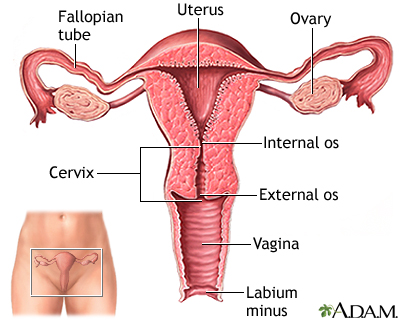
These cells are also found in a woman's ovaries, and in very rare cases lead to cancer. SLCT starts in the female ovaries, mostly in one ovary. The cancer cells release a male sex hormone. As a result, the woman may develop symptoms such as:
- A deep voice
- Enlarged clitoris
- Facial hair
- Loss in breast size
- Stopping of menstrual periods
Pain in the lower belly (pelvic area) is another symptom. It occurs due to the tumor pressing on nearby structures.
Exams and Tests
Your health care provider will perform a physical exam and a pelvic exam, and ask about your symptoms.
Tests will be ordered to check the levels of female and male hormones, including testosterone.
An ultrasound or CT scan will likely be done to find out where the tumor is and its size and shape.
Treatment
Surgery is done to remove one or both ovaries.
If the tumor is at an advanced stage, chemotherapy or radiation therapy may be done after surgery.
Outlook (Prognosis)
Early treatment results in a good outcome. Feminine characteristics usually return after surgery. But male characteristics resolve more slowly.
For more advanced stage tumors, the outlook is less positive.
Related Information
TestosteroneOvarian cancer
Virilization
References
Beffa LB, Sung CJ, DiSilvestro PA. Germ cell, stromal, and other ovarian tumors. In: Creasman WT, Mutch DG, Mannel RS, Tewari KS, eds. DiSaia and Creasman Clinical Gynecologic Oncology. 10th ed. Philadelphia, PA: Elsevier; 2023:chap 10.
Einhorn LH. Testicular cancer. In: Goldman L, Cooney KA, eds. Goldman-Cecil Medicine. 27th ed. Philadelphia, PA: Elsevier; 2024:chap 185.
Friedlander TW, Small E. Testicular cancer. In: Niederhuber JE, Armitage JO, Kastan MB, Doroshow JH, Tepper JE, eds. Abeloff's Clinical Oncology. 6th ed. Philadelphia, PA: Elsevier; 2020:chap 83.
Smith RP. Sertoli-Leydig cell tumor (arrhenoblastoma). In: Smith RP, ed. Netter's Obstetrics & Gynecology. 4th ed. Philadelphia, PA: Elsevier; 2024:chap 165.
Stephenson AJ, Gilligan TD. Neoplasms of the testis. In: Dmochowski RR, Kavoussi LR, Peters CA, et al, eds. Campbell-Walsh-Wein Urology. 13th ed. Philadelphia, PA: Elsevier; 2026:chap 79.
BACK TO TOPReview Date: 5/1/2026
Reviewed By: Warren Brenner, MD, Oncologist, Lynn Cancer Institute, Boca Raton, FL. Review provided by VeriMed Healthcare Network. Also reviewed by David C. Dugdale, MD, Medical Director, Brenda Conaway, Editorial Director, and the A.D.A.M. Editorial team.
 | A.D.A.M., Inc. is accredited by URAC, for Health Content Provider (www.urac.org). URAC's accreditation program is an independent audit to verify that A.D.A.M. follows rigorous standards of quality and accountability. A.D.A.M. is among the first to achieve this important distinction for online health information and services. Learn more about A.D.A.M.'s editorial policy, editorial process and privacy policy. A.D.A.M. is also a founding member of Hi-Ethics. This site complies with the HONcode standard for trustworthy health information: verify here. |
The information provided herein should not be used during any medical emergency or for the diagnosis or treatment of any medical condition. A licensed medical professional should be consulted for diagnosis and treatment of any and all medical conditions. Links to other sites are provided for information only -- they do not constitute endorsements of those other sites. No warranty of any kind, either expressed or implied, is made as to the accuracy, reliability, timeliness, or correctness of any translations made by a third-party service of the information provided herein into any other language.
© 1997-
2026 A.D.A.M., a business unit of Ebix, Inc. Any duplication or distribution of the information contained herein is strictly prohibited.
All content on this site including text, images, graphics, audio, video, data, metadata, and compilations is protected by copyright and other intellectual property laws. You may view the content for personal, noncommercial use. Any other use requires prior written consent from Ebix. You may not copy, reproduce, distribute, transmit, display, publish, reverse-engineer, adapt, modify, store beyond ordinary browser caching, index, mine, scrape, or create derivative works from this content. You may not use automated tools to access or extract content, including to create embeddings, vectors, datasets, or indexes for retrieval systems. Use of any content for training, fine-tuning, calibrating, testing, evaluating, or improving AI systems of any kind is prohibited without express written consent. This includes large language models, machine learning models, neural networks, generative systems, retrieval-augmented systems, and any software that ingests content to produce outputs. Any unauthorized use of the content including AI-related use is a violation of our rights and may result in legal action, damages, and statutory penalties to the fullest extent permitted by law. Ebix reserves the right to enforce its rights through legal, technological, and contractual measures.
