

Health Library
Acute bronchitis
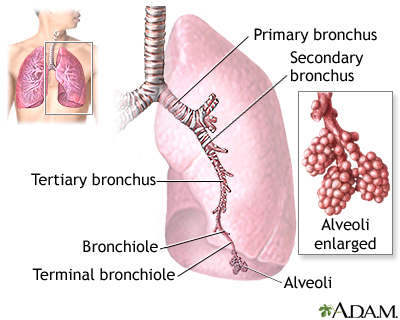
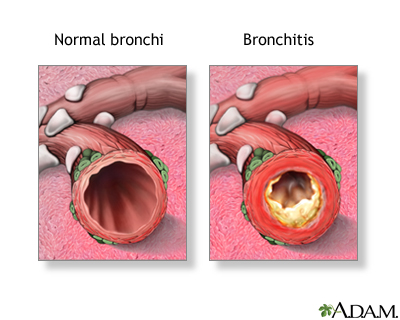
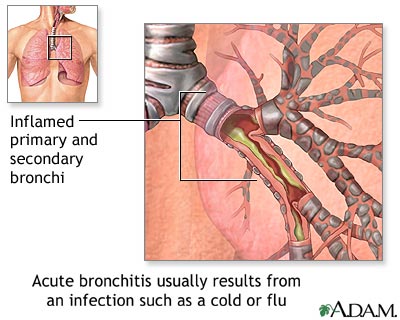
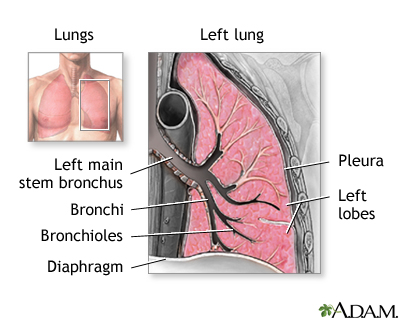
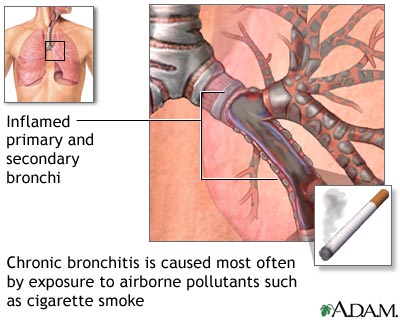
Acute bronchitis is swelling and inflamed tissue in the bronchi, the main passages that carry air to the lungs. This swelling causes cough and sometimes coughing up mucus. It may narrow the airways, which makes it harder to breathe. Acute means the symptoms have been present only for a short time.
Images
I Would Like to Learn About:
Causes
When acute bronchitis occurs, it almost always comes after having a cold or flu-like illness. At first, it affects your nose, sinuses, and throat. Then it spreads to the airways that lead to your lungs. Bronchitis is usually caused by a virus.
Sometimes, bacteria also infect your airways. This is more common in people with chronic obstructive pulmonary disease (COPD).
Chronic bronchitis is a long-term condition. To be diagnosed with chronic bronchitis, you must have a cough with mucus on most days for at least 3 months.
Symptoms
Some symptoms of acute bronchitis are:
- Chest discomfort
- Cough that produces mucus -- the mucus may be clear or yellow-green
- Fatigue
- Fever -- usually low-grade
- Shortness of breath that gets worse with activity
- Wheezing, in people with asthma
Even after acute bronchitis has cleared, you may have a dry or nagging cough that lasts for 1 to 4 weeks.
Sometimes it can be hard to know if you have pneumonia or bronchitis. If you have pneumonia, you are more likely to have a high fever and chills, feel sicker, or feel more short of breath.
Exams and Tests
Your health care provider will listen to the breathing sounds in your lungs with a stethoscope. Your breathing may sound abnormal or rough.
Tests may include:
- Chest x-ray, if your provider suspects pneumonia
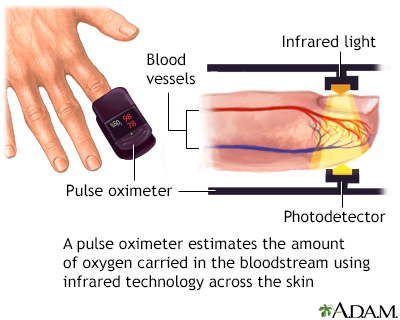
- Pulse oximetry, a painless test that helps determine the amount of oxygen in your blood by using a device placed on the end of your finger
Treatment
Most people DO NOT need antibiotics for acute bronchitis caused by a virus. The infection will almost always go away on its own within 1 week, though a mild cough may persist for up to 4 weeks. Doing these things may help you feel better:
- Drink plenty of fluids.
- If you have asthma or another chronic lung condition, use your inhaler.
- Get plenty of rest.
- Take ibuprofen or acetaminophen if you have a fever or body aches. DO NOT give aspirin to people under age 18.
- Breathe moist air by using a humidifier or steaming up the bathroom.
Certain medicines that you can buy without a prescription can help break up or loosen mucus. Look for the word "guaifenesin" on the label. If needed, ask the pharmacist for help finding it.
If your symptoms do not improve or if you are wheezing, your provider may prescribe an inhaler to open your airways.
If your provider thinks you also have bacteria in your airways, they may prescribe antibiotics. This medicine will only get rid of bacteria, not viruses.
Your provider may also prescribe corticosteroid medicine to reduce swelling in your lungs.
If you have influenza and it is caught in the first 48 hours after getting sick, your provider might also prescribe antiviral medicine.
Other tips include:
- DO NOT smoke.
- Avoid secondhand smoke and air pollution, if possible.
- Wash your hands (and your children's hands) often to avoid spreading viruses and other germs.
Outlook (Prognosis)
Except for the cough, symptoms usually go away in 7 to 10 days if you do not have a lung disorder. Coughing often lasts for 2 to 3 weeks.
When to Contact a Medical Professional
Contact your provider if you:
- Have a cough on most days, or have a cough that keeps returning
- Are coughing up blood
- Have a high fever or shaking chills
- Have a low-grade fever for 3 or more days
- Have thick, yellow-green mucus, especially if it has a bad smell
- Feel short of breath or have chest pain
- Have a chronic illness, like heart or lung disease
Related Information
RespiratoryCough
Chronic obstructive pulmonary disease (COPD)
Allergies
Asthma
Cor pulmonale
COPD - what to ask your doctor
Using oxygen at home - what to ask your doctor
References
Bearman GM, Wenzel RP. Acute bronchitis and tracheitis. In: Goldman L, Cooney KA, eds. Goldman-Cecil Medicine. 27th ed. Philadelphia, PA: Elsevier; 2024:chap 84.
Centers for Disease Control and Prevention website. Acute bronchitis. Chest cold (acute bronchitis) basics. www.cdc.gov/acute-bronchitis/about/. Updated April 17, 2024. Accessed March 10, 2026.
Cherry JD, Doustmohammadi S. Acute bronchitis. In: Cherry JD, Kaplan SL, Harrison GJ, Steinbach WJ, Hotez PJ, Williams JV, eds. Feigin and Cherry's Textbook Of Pediatric Infectious Diseases. 9th ed. Philadelphia, PA: Elsevier; 2025:chap 19.
Walsh EE. Acute bronchitis. In: Blaser MJ, Cohen JI, Holland SM, et al, eds. Mandell, Douglas and Bennett's Principles and Practice of Infectious Diseases. 10th ed. Philadelphia, PA: Elsevier; 2025:chap 67.
BACK TO TOPReview Date: 2/27/2026
Reviewed By: Jacob Berman, MD, MPH, Associate Professor of Medicine, Division of General Internal Medicine, University of Washington School of Medicine, Seattle, WA. Also reviewed by David C. Dugdale, MD, Medical Director, Brenda Conaway, Editorial Director, and the A.D.A.M. Editorial team.
 | A.D.A.M., Inc. is accredited by URAC, for Health Content Provider (www.urac.org). URAC's accreditation program is an independent audit to verify that A.D.A.M. follows rigorous standards of quality and accountability. A.D.A.M. is among the first to achieve this important distinction for online health information and services. Learn more about A.D.A.M.'s editorial policy, editorial process and privacy policy. A.D.A.M. is also a founding member of Hi-Ethics. This site complies with the HONcode standard for trustworthy health information: verify here. |
The information provided herein should not be used during any medical emergency or for the diagnosis or treatment of any medical condition. A licensed medical professional should be consulted for diagnosis and treatment of any and all medical conditions. Links to other sites are provided for information only -- they do not constitute endorsements of those other sites. No warranty of any kind, either expressed or implied, is made as to the accuracy, reliability, timeliness, or correctness of any translations made by a third-party service of the information provided herein into any other language.
© 1997-
2026 A.D.A.M., a business unit of Ebix, Inc. Any duplication or distribution of the information contained herein is strictly prohibited.
All content on this site including text, images, graphics, audio, video, data, metadata, and compilations is protected by copyright and other intellectual property laws. You may view the content for personal, noncommercial use. Any other use requires prior written consent from Ebix. You may not copy, reproduce, distribute, transmit, display, publish, reverse-engineer, adapt, modify, store beyond ordinary browser caching, index, mine, scrape, or create derivative works from this content. You may not use automated tools to access or extract content, including to create embeddings, vectors, datasets, or indexes for retrieval systems. Use of any content for training, fine-tuning, calibrating, testing, evaluating, or improving AI systems of any kind is prohibited without express written consent. This includes large language models, machine learning models, neural networks, generative systems, retrieval-augmented systems, and any software that ingests content to produce outputs. Any unauthorized use of the content including AI-related use is a violation of our rights and may result in legal action, damages, and statutory penalties to the fullest extent permitted by law. Ebix reserves the right to enforce its rights through legal, technological, and contractual measures.
