

Health Library
Cystitis - noninfectious
Abacterial cystitis; Radiation cystitis; Chemical cystitis; Urethral syndrome - acute; Bladder pain syndrome; Painful bladder disease complex; Dysuria - noninfectious cystitis; Frequent urination - noninfectious cystitis; Painful urination - noninfectious; Interstitial cystitis
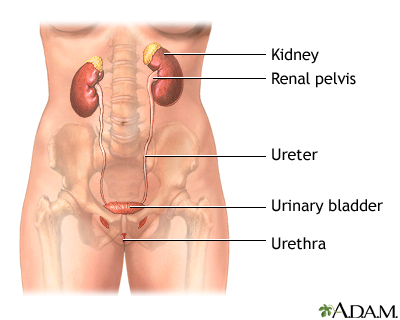
Cystitis is a problem in which pain, pressure, or burning in the bladder is present. Most often, this problem is caused by germs such as bacteria. Cystitis is called noninfectious when there is no infection.
Images
I Would Like to Learn About:
Causes
The exact cause of noninfectious cystitis is often not known. It is more common in women than men.
The problem has been linked to:
- Use of baths and feminine hygiene sprays
- Use of spermicide jellies, gels, foams, and sponges
- Radiation therapy to the pelvis area
- Certain types of chemotherapy medicines
- History of severe or repeated bladder infections
Certain foods, such as spicy or acidic foods, tomatoes, artificial sweeteners, caffeine, chocolate, and alcohol, can cause bladder symptoms.
Stress may make symptoms worse, but stress does not cause symptoms.
Symptoms
Common symptoms include:
- Pressure or pain in the lower pelvis
- Painful urination
- Frequent need to urinate
- Urgent need to urinate
- Problems holding urine
- Need to urinate at night
- Abnormal urine color, cloudy urine
- Blood in the urine
- Foul or strong urine odor
Other symptoms may include:
Exams and Tests
A urinalysis may reveal red blood cells (RBCs) and some white blood cells (WBCs). Urine may be examined under a microscope to look for cancerous cells.
A urine culture (clean catch) is done to look for a bacterial infection.
A cystoscopy (use of lighted instrument to look inside the bladder) may be done if you have:
- Symptoms related to radiation therapy or chemotherapy
- Symptoms that do not get better with treatment
- Blood in the urine
Treatment
The goal of treatment is to manage your symptoms.
This may include:
- Medicines to help your bladder relax. They can reduce the strong urge to urinate or need to urinate frequently. These are called anticholinergic medicines. Possible side effects include increased heart rate, low blood pressure, dry mouth, and constipation. Another class of medicine is known as a beta 3 receptor blocker. A possible side effect can be an increase in blood pressure but this does not occur often.
- A medicine called phenazopyridine (Pyridium) to help relieve pain and burning with urination.
- Medicines to help reduce pain.
- Surgery is rarely done. It may be performed if a person has symptoms that do not go away with other treatments, trouble passing urine, or blood in the urine.
Other things that may help include:
- Avoiding foods and fluids that irritate the bladder. These include spicy and acidic foods as well as alcohol, citrus juices, and caffeine, and foods that contain them.
- Performing bladder training exercises to help you schedule times to try to urinate and to delay urination at all other times. One method is to force yourself to delay urinating despite the urge to urinate in between these times. As you become better at waiting this long, slowly increase the time intervals by 15 minutes. Try to reach a goal of urinating every 3 to 4 hours.
- Avoiding pelvic muscle strengthening exercises called Kegel exercises.
- Pelvic floor physical therapy to relieve pain in the abdominal and pelvic areas and to release tight and scarred tissues.
Outlook (Prognosis)
Most cases of cystitis are uncomfortable, but the symptoms most often get better over time. Symptoms can improve if you are able to identify and avoid food triggers.
Possible Complications
Complications may include:
- Ulceration of bladder wall
- Painful sex
- Sleep loss
- Depression
When to Contact a Medical Professional
Contact your health care provider if:
- You have symptoms of cystitis
- You have been diagnosed with cystitis and your symptoms get worse, or you have new symptoms, especially fever, blood in the urine, back or flank pain, and vomiting
Prevention
Avoid products that may irritate the bladder such as:
- Bubble baths
- Feminine hygiene sprays
- Tampons (especially scented products)
- Spermicidal jellies
If you need to use such products, try to find those that do not cause irritation for you.
Related Information
Urinary tract infection - adultsRadiation therapy
Chemotherapy
Interstitial cystitis
Urethral stricture
Bladder cancer
Anemia
References
American Urological Association website. Diagnosis and Treatment Interstitial Cystitis/Bladder Pain Syndrome (2022). www.auanet.org/guidelines/guidelines/diagnosis-and-treatment-interstitial-cystitis/bladder-pain-syndrome-(2022). Accessed February 6, 2026.
Lai HH, Moldwin RM. Interstitial cystitis/bladder pain syndrome and related disorders. In: Dmochowski RR, Kavoussi LR, Peters CA, et al, eds. Campbell-Walsh-Wein Urology. 13th ed. Philadelphia, PA: Elsevier; 2026:chap 28.
Lentz G, Miller J. Lower urinary tract function and disorders: Physiology of micturition, voiding dysfunction, urinary incontinence, urinary tract infections, and painful bladder syndrome. In: Gershenson DM, Lentz GM, Valea FA, Lobo RA, eds. Comprehensive Gynecology. 8th ed. Philadelphia, PA: Elsevier; 2022:chap 21.
National Institute of Diabetes and Digestive and Kidney Diseases website. Interstitial cystitis (bladder pain syndrome). www.niddk.nih.gov/health-information/urologic-diseases/interstitial-cystitis-bladder-pain-syndrome/all-content. Updated July 2024. Accessed February 6, 2026.
BACK TO TOPReview Date: 1/12/2026
Reviewed By: Kelly L. Stratton, MD, FACS, Associate Professor, Department of Urology, University of Oklahoma Health Sciences Center, Oklahoma City, OK. Also reviewed by David C. Dugdale, MD, Medical Director, Brenda Conaway, Editorial Director, and the A.D.A.M. Editorial team.
 | A.D.A.M., Inc. is accredited by URAC, for Health Content Provider (www.urac.org). URAC's accreditation program is an independent audit to verify that A.D.A.M. follows rigorous standards of quality and accountability. A.D.A.M. is among the first to achieve this important distinction for online health information and services. Learn more about A.D.A.M.'s editorial policy, editorial process and privacy policy. A.D.A.M. is also a founding member of Hi-Ethics. This site complies with the HONcode standard for trustworthy health information: verify here. |
The information provided herein should not be used during any medical emergency or for the diagnosis or treatment of any medical condition. A licensed medical professional should be consulted for diagnosis and treatment of any and all medical conditions. Links to other sites are provided for information only -- they do not constitute endorsements of those other sites. No warranty of any kind, either expressed or implied, is made as to the accuracy, reliability, timeliness, or correctness of any translations made by a third-party service of the information provided herein into any other language.
© 1997-
2026 A.D.A.M., a business unit of Ebix, Inc. Any duplication or distribution of the information contained herein is strictly prohibited.
All content on this site including text, images, graphics, audio, video, data, metadata, and compilations is protected by copyright and other intellectual property laws. You may view the content for personal, noncommercial use. Any other use requires prior written consent from Ebix. You may not copy, reproduce, distribute, transmit, display, publish, reverse-engineer, adapt, modify, store beyond ordinary browser caching, index, mine, scrape, or create derivative works from this content. You may not use automated tools to access or extract content, including to create embeddings, vectors, datasets, or indexes for retrieval systems. Use of any content for training, fine-tuning, calibrating, testing, evaluating, or improving AI systems of any kind is prohibited without express written consent. This includes large language models, machine learning models, neural networks, generative systems, retrieval-augmented systems, and any software that ingests content to produce outputs. Any unauthorized use of the content including AI-related use is a violation of our rights and may result in legal action, damages, and statutory penalties to the fullest extent permitted by law. Ebix reserves the right to enforce its rights through legal, technological, and contractual measures.
