

Health Library
Abdominal thrusts
Choking - Heimlich maneuver
Choking is when someone is having a very hard time breathing because food, a toy, or other object is blocking the throat or windpipe (airway).
A choking person's airway may be blocked so that not enough oxygen reaches the lungs. Without oxygen, brain damage can occur in as little as 4 to 6 minutes. Rapid first aid for choking can save a person's life.
Abdominal thrusts is an emergency technique to help clear someone's airway.
- The procedure is done on someone who is choking and also conscious.
- Most experts do not recommend abdominal thrusts for infants less than 1 year old. There are different instructions for helping infants under 1 year old who are choking.
- You can also perform the maneuver on yourself.
Images
I Would Like to Learn About:
First Aid
First ask, "Are you choking? Can you speak?" Do not perform first aid if the person is coughing forcefully and is able to speak. A strong cough can often dislodge the object.
If the person cannot speak or is having a hard time breathing, you need to act fast to help the person. You should perform repeated cycles of 5 back blows followed by 5 abdominal thrusts, until the object comes out or the person becomes unconscious. In pregnant or obese people, chest thrusts should be done instead of abdominal thrusts.
To perform back blows:
- Stand behind the person. For a child, you may have to kneel.
- Wrap one arm around to support the person's upper body. Lean the person forward until the chest is about parallel to the ground.
- Use the heel of your other hand to deliver a firm blow between the person's shoulder blades.
- Check if the object is dislodged.
- Give 5 back blows.
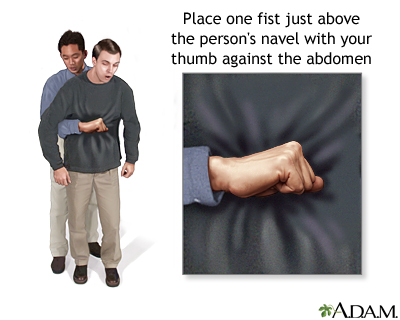
To perform abdominal thrusts (Heimlich maneuver):
- If the person is sitting or standing, position yourself behind the person and reach your arms around their waist. For a child, you may have to kneel.
- Place your fist, thumb side in, just above the person's navel (belly button).
- Grasp the fist tightly with your other hand.
- Make quick, upward and inward thrusts with your fist.
- If the person is lying on their back, straddle the person facing the head. Push your grasped fist upward and inward in a movement similar to the one above.
- Check if the object is dislodged.
- Give 5 abdominal thrusts.
FOR PREGNANT OR OBESE PEOPLE
- Wrap your arms around the person's CHEST.
- Place your fist on the MIDDLE of the breastbone between the nipples.
- Make firm, backward thrusts.
- Give 5 rounds chest thrusts.
You may need to repeat the procedure several times before the object is dislodged. If repeated attempts do not free the airway, shout for help. Tell someone to call 911 or the local emergency number.
If the person loses consciousness, start CPR. Abdominal thrusts are for a conscious choking victim. Chest compressions are for an unconscious choking victim.
Related Information
TracheostomyChoking - infant under 1 year
Choking - adult or child over 1 year
Choking - unconscious adult or child over 1 year
References
American Heart Association website. Highlights of the 2025 American Heart Association guidelines for CPR and ECC. cpr.heart.org/-/media/CPR-Files/2025-documents-for-cpr-heart-edits-posting/Resuscitation-Science/252500_Hghlghts_2025ECCGuidelines.pdf?sc_lang=en. Accessed February 10, 2026.
Easter JS. Pediatric resuscitation. In: Walls RM, ed. Rosen's Emergency Medicine: Concepts and Clinical Practice. 10th ed. Philadelphia, PA: Elsevier; 2023:chap 158.
Goodloe JM, Soulek J. Foreign bodies. In: Walls RM, ed. Rosen's Emergency Medicine: Concepts and Clinical Practice. 10th ed. Philadelphia, PA: Elsevier; 2023:chap 51.
Haas NL, Kurz MC. Adult resuscitation. In: Walls RM, ed. Rosen's Emergency Medicine: Concepts and Clinical Practice. 10th ed. Philadelphia, PA: Elsevier; 2023:chap 5.
Hewett Brumberg EK, Douma MJ, Alibertis K, et al. American Heart Association and American Red Cross. 2024 American Heart Association and American Red Cross guidelines for first aid. Circulation. 2024;150(24):e519-e579. PMID: 39540278 pubmed.ncbi.nlm.nih.gov/39540278/.
Joyner BL Jr, Dewan M, Bavare A, et al, eds. Part 6: Pediatric basic life support: 2025 American Heart Association and American Academy of Pediatrics guidelines for cardiopulmonary resuscitation and emergency cardiovascular care. Circulation. 2025 Oct 21;152(16_suppl_2):S424-S447. PMID: 41122891 pubmed.ncbi.nlm.nih.gov/41122891/.
Kleinman ME, Buick JE, Huber N, et al. Part 7: Adult basic life support: 2025 American Heart Association guidelines for cardiopulmonary resuscitation and emergency cardiovascular care. Circulation. 2025;152(16_suppl_2):S448-S478. PMID: 41122888 pubmed.ncbi.nlm.nih.gov/41122888/.
Rose E. Pediatric upper airway obstruction and infections. In: Walls RM, ed. Rosen's Emergency Medicine: Concepts and Clinical Practice. 10th ed. Philadelphia, PA: Elsevier; 2023:chap 162.
BACK TO TOPReview Date: 2/17/2026
Reviewed By: Jesse Borke, MD, CPE, FAAEM, FACEP, Attending Physician at Kaiser Permanente, Orange County, CA. Also reviewed by David C. Dugdale, MD, Medical Director, Brenda Conaway, Editorial Director, and the A.D.A.M. Editorial team.
 | A.D.A.M., Inc. is accredited by URAC, for Health Content Provider (www.urac.org). URAC's accreditation program is an independent audit to verify that A.D.A.M. follows rigorous standards of quality and accountability. A.D.A.M. is among the first to achieve this important distinction for online health information and services. Learn more about A.D.A.M.'s editorial policy, editorial process and privacy policy. A.D.A.M. is also a founding member of Hi-Ethics. This site complies with the HONcode standard for trustworthy health information: verify here. |
The information provided herein should not be used during any medical emergency or for the diagnosis or treatment of any medical condition. A licensed medical professional should be consulted for diagnosis and treatment of any and all medical conditions. Links to other sites are provided for information only -- they do not constitute endorsements of those other sites. No warranty of any kind, either expressed or implied, is made as to the accuracy, reliability, timeliness, or correctness of any translations made by a third-party service of the information provided herein into any other language.
© 1997-
2026 A.D.A.M., a business unit of Ebix, Inc. Any duplication or distribution of the information contained herein is strictly prohibited.
All content on this site including text, images, graphics, audio, video, data, metadata, and compilations is protected by copyright and other intellectual property laws. You may view the content for personal, noncommercial use. Any other use requires prior written consent from Ebix. You may not copy, reproduce, distribute, transmit, display, publish, reverse-engineer, adapt, modify, store beyond ordinary browser caching, index, mine, scrape, or create derivative works from this content. You may not use automated tools to access or extract content, including to create embeddings, vectors, datasets, or indexes for retrieval systems. Use of any content for training, fine-tuning, calibrating, testing, evaluating, or improving AI systems of any kind is prohibited without express written consent. This includes large language models, machine learning models, neural networks, generative systems, retrieval-augmented systems, and any software that ingests content to produce outputs. Any unauthorized use of the content including AI-related use is a violation of our rights and may result in legal action, damages, and statutory penalties to the fullest extent permitted by law. Ebix reserves the right to enforce its rights through legal, technological, and contractual measures.
