

Health Library
Polymorphous light eruption
Polymorphic light eruption; Photodermatosis; PMLE; Benign summer light eruption
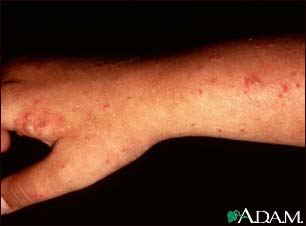
Polymorphous light eruption (PMLE) is a common skin reaction in people who are sensitive to sunlight (ultraviolet light).
Images
I Would Like to Learn About:
Causes
The exact cause of PMLE is unknown. However, it may be genetic. Health care providers think it is a type of delayed allergic reaction. It is common among young women who live in moderate (temperate) climates.
Symptoms
Polymorphous means taking on different forms, and eruption means rash. As the name suggests, symptoms of PMLE are rash-like and vary among people.
PMLE most often occurs in spring and early summer on areas of the body exposed to the sun.
Symptoms usually appear within 1 to 4 days after exposure to sunlight. They include any of the following:
- Small bumps (papules) or blisters
- Redness or scaling of the skin
- Itching or burning of the affected skin
- Swelling, or even blisters (not often seen)
Exams and Tests
Your provider will examine your skin. Usually, your provider can diagnose PMLE based on your description of the symptoms.
Tests that may be done include:
- Phototesting, during which your skin is exposed to special ultraviolet light to check if your skin develops a rash
- Removing a small amount of skin (skin biopsy) for examination to check for other diseases
Treatment
Steroid creams or ointments containing vitamin D may be prescribed by your provider. They are used 2 or 3 times a day at the start of the eruption. Steroid or other types of pills may be used for more severe cases.
Phototherapy may also be prescribed. Phototherapy is a medical treatment in which your skin is carefully exposed to ultraviolet light. When used in the spring, it may help your skin become more tolerant to the sun.
Outlook (Prognosis)
Many people become less sensitive to sunlight over time.
When to Contact a Medical Professional
Contact your provider if PMLE symptoms do not respond to treatments.
Prevention
Protecting your skin from the sun can help prevent PMLE symptoms:
- Avoid sun exposure during hours of peak sun ray intensity.
- Use sunscreen. Sun protection with broad spectrum sunblock that works against UVA rays is important.
- Apply generous amounts of sunscreen with a sun protection factor (SPF) of at least 30. Pay special attention to your face, nose, ears, neck, shoulders and hands.
- Apply sunscreen 30 minutes before sun exposure so that it has time to penetrate the skin. Re-apply after swimming and every 2 hours while you are outdoors.
- Wear a sun hat.
- Wear sunglasses with UV protection.
- Use a lip balm with sunscreen.
Related Information
AcneVesicles
Allergic reactions
References
James WD. Dermatoses resulting from physical factors. In: James WD, ed. Andrews' Diseases of the Skin: Clinical Dermatology. 14th ed. Philadelphia, PA: Elsevier; 2026:chap 3.
Patterson JW. Reactions to physical agents. In: Patterson JW, ed. Weedon's Skin Pathology. 6th ed. Philadelphia, PA: Elsevier Limited; 2025:chap 22.
BACK TO TOPReview Date: 6/3/2025
Reviewed By: Ramin Fathi, MD, FAAD, Director, Phoenix Surgical Dermatology Group, Phoenix, AZ. Also reviewed by David C. Dugdale, MD, Medical Director, Brenda Conaway, Editorial Director, and the A.D.A.M. Editorial team.
 | A.D.A.M., Inc. is accredited by URAC, for Health Content Provider (www.urac.org). URAC's accreditation program is an independent audit to verify that A.D.A.M. follows rigorous standards of quality and accountability. A.D.A.M. is among the first to achieve this important distinction for online health information and services. Learn more about A.D.A.M.'s editorial policy, editorial process and privacy policy. A.D.A.M. is also a founding member of Hi-Ethics. This site complies with the HONcode standard for trustworthy health information: verify here. |
The information provided herein should not be used during any medical emergency or for the diagnosis or treatment of any medical condition. A licensed medical professional should be consulted for diagnosis and treatment of any and all medical conditions. Links to other sites are provided for information only -- they do not constitute endorsements of those other sites. No warranty of any kind, either expressed or implied, is made as to the accuracy, reliability, timeliness, or correctness of any translations made by a third-party service of the information provided herein into any other language.
© 1997-
2026 A.D.A.M., a business unit of Ebix, Inc. Any duplication or distribution of the information contained herein is strictly prohibited.
All content on this site including text, images, graphics, audio, video, data, metadata, and compilations is protected by copyright and other intellectual property laws. You may view the content for personal, noncommercial use. Any other use requires prior written consent from Ebix. You may not copy, reproduce, distribute, transmit, display, publish, reverse-engineer, adapt, modify, store beyond ordinary browser caching, index, mine, scrape, or create derivative works from this content. You may not use automated tools to access or extract content, including to create embeddings, vectors, datasets, or indexes for retrieval systems. Use of any content for training, fine-tuning, calibrating, testing, evaluating, or improving AI systems of any kind is prohibited without express written consent. This includes large language models, machine learning models, neural networks, generative systems, retrieval-augmented systems, and any software that ingests content to produce outputs. Any unauthorized use of the content including AI-related use is a violation of our rights and may result in legal action, damages, and statutory penalties to the fullest extent permitted by law. Ebix reserves the right to enforce its rights through legal, technological, and contractual measures.
