

Health Library
Lifting and bending the right way
Nonspecific back pain - lifting; Backache - lifting; Sciatica - lifting; Lumbar pain - lifting; Chronic back pain - lifting; Herniated disk - lifting; Slipped disk - lifting
Images
I Would Like to Learn About:
Description
Many people injure their backs when they lift objects the wrong way. When you reach your 30's, you are more likely to hurt your back when you bend to lift something up or put it down.
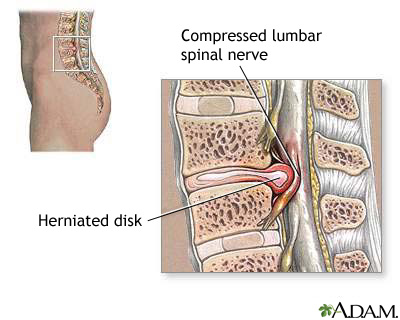
This may be because you have injured the muscles, ligaments, or disks in your spine in the past. Also, as we get older our muscles and ligaments become less flexible. And, the disks that act as cushions between the bones of our spine become less elastic as we age. All of these things make us more prone to having a back injury.
How you can Prevent Injury
Know how much you can safely lift. Think about how much you have lifted in the past and how easy or hard that was. If an object seems too heavy or awkward, get help with it.
Warm up or stretch before you lift heavy weights. The better conditioned your body and your joints are, the less injury or pain you will have.
If your work requires you to do lifting that may not be safe for your back, talk to your supervisor. Try to determine the most weight you should have to lift. You may need to meet with a physical therapist or occupational therapist to learn how to safely lift this amount of weight.
Know how to lift in the correct way. To help prevent back pain and injury when you bend and lift:
- Spread your feet apart to about shoulder width to give your body a wide base of support.
- Stand as close as possible to the object you are lifting.
- Bend at your knees, not at your waist or back.
- Tighten your stomach muscles as you lift the object up or lower it down.
- Hold the object as close to your body as you can.
- Slowly lift, using your muscles in your hips and knees.
- As you stand up with the object, do not bend forward.
- Do not twist your back while you bend to reach the object, lift the object, or carry the object.
- Squat as you set the object down, using the muscles in your knees and hips. Keep your back straight when you squat down.
References
Dixit R. Low back pain. In: Firestein GS, McInnes IB, Koretzky GA, Mikuls TR, Neogi T, O'Dell JR, eds. Firestein & Kelley's Textbook of Rheumatology. 12th ed. Philadelphia, PA: Elsevier; 2025:chap 47.
Hertel J, Onate J, Kaminski T. Injury prevention. In: Miller MD, Thompson SR, eds. DeLee, Drez, & Miller's Orthopaedic Sports Medicine. 5th ed. Philadelphia, PA: Elsevier; 2020:chap 34.
BACK TO TOPReview Date: 9/2/2025
Reviewed By: C. Benjamin Ma, MD, Professor, Chief, Sports Medicine and Shoulder Service, UCSF Department of Orthopaedic Surgery, San Francisco, CA. Also reviewed by David C. Dugdale, MD, Medical Director, Brenda Conaway, Editorial Director, and the A.D.A.M. Editorial team.
 | A.D.A.M., Inc. is accredited by URAC, for Health Content Provider (www.urac.org). URAC's accreditation program is an independent audit to verify that A.D.A.M. follows rigorous standards of quality and accountability. A.D.A.M. is among the first to achieve this important distinction for online health information and services. Learn more about A.D.A.M.'s editorial policy, editorial process and privacy policy. A.D.A.M. is also a founding member of Hi-Ethics. This site complies with the HONcode standard for trustworthy health information: verify here. |
The information provided herein should not be used during any medical emergency or for the diagnosis or treatment of any medical condition. A licensed medical professional should be consulted for diagnosis and treatment of any and all medical conditions. Links to other sites are provided for information only -- they do not constitute endorsements of those other sites. No warranty of any kind, either expressed or implied, is made as to the accuracy, reliability, timeliness, or correctness of any translations made by a third-party service of the information provided herein into any other language.
© 1997-
2026 A.D.A.M., a business unit of Ebix, Inc. Any duplication or distribution of the information contained herein is strictly prohibited.
All content on this site including text, images, graphics, audio, video, data, metadata, and compilations is protected by copyright and other intellectual property laws. You may view the content for personal, noncommercial use. Any other use requires prior written consent from Ebix. You may not copy, reproduce, distribute, transmit, display, publish, reverse-engineer, adapt, modify, store beyond ordinary browser caching, index, mine, scrape, or create derivative works from this content. You may not use automated tools to access or extract content, including to create embeddings, vectors, datasets, or indexes for retrieval systems. Use of any content for training, fine-tuning, calibrating, testing, evaluating, or improving AI systems of any kind is prohibited without express written consent. This includes large language models, machine learning models, neural networks, generative systems, retrieval-augmented systems, and any software that ingests content to produce outputs. Any unauthorized use of the content including AI-related use is a violation of our rights and may result in legal action, damages, and statutory penalties to the fullest extent permitted by law. Ebix reserves the right to enforce its rights through legal, technological, and contractual measures.
